
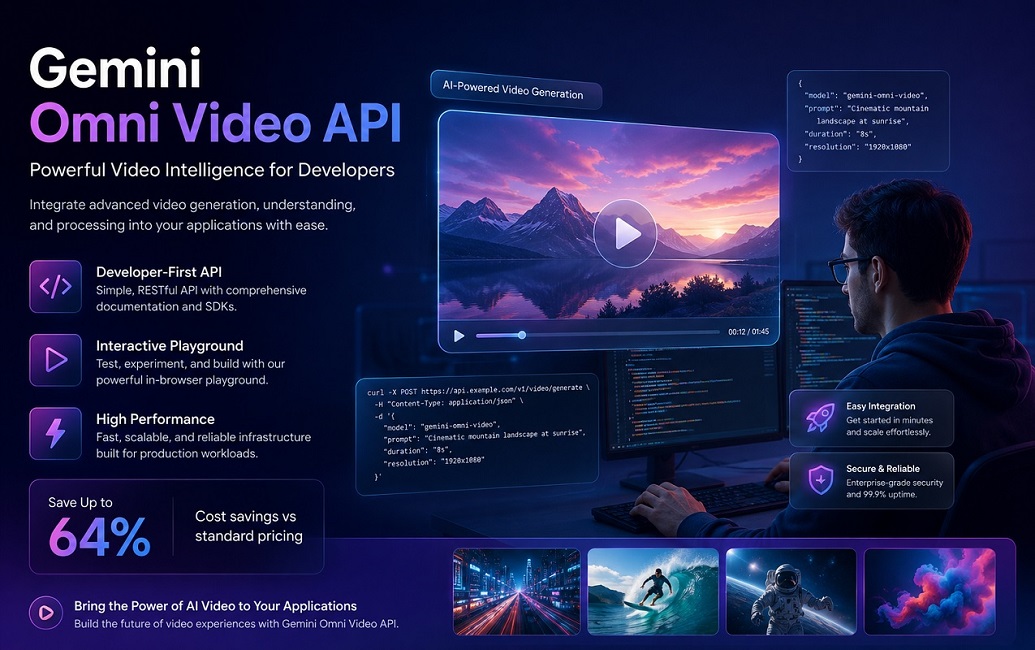
Video generation and multimodal applications are becoming increasingly important for developers building next-generation digital products. The Gemini Omni Video API provides developers with a practical way to access advanced video capabilities through an API-focused environment designed for integration and experimentation. Instead of treating video generation as a standalone creative tool, developers can incorporate video functionality into applications, platforms, automated workflows, and AI-powered services. This approach can help teams move from manual experimentation toward scalable product development.
For developers, API access creates opportunities to connect video intelligence with existing software infrastructure. Applications can send requests programmatically, process generated outputs, and incorporate video functionality into broader user experiences. This can be particularly useful for SaaS platforms, marketing applications, educational products, content systems, media tools, and internal automation. A developer-friendly API environment also reduces the need to build complicated video-generation infrastructure from scratch, allowing engineering teams to focus more heavily on product logic and customer-facing features.
Why API Access Matters for Video Applications
Traditional video workflows can require multiple disconnected tools for generation, processing, storage, and delivery. An API-based model simplifies this architecture by giving developers a programmable interface that can become part of an application’s existing workflow. Rather than requiring users to manually operate separate software, developers can create interfaces where video-related functionality is triggered directly from their own products.
This flexibility is especially valuable when video generation needs to happen repeatedly or at scale. A content platform, for example, could integrate automated video creation into a publishing workflow, while a marketing application could allow customers to generate visual content from within a dashboard. Developers can also build custom business logic around API requests, enabling applications to determine when video should be generated, what inputs should be used, and how resulting content should move through the rest of the system.
Building Applications Through a Developer-First Workflow
A developer-first video platform can make experimentation much easier because engineers can test functionality before committing substantial development resources. The API environment can serve as a bridge between an initial prototype and a production application, allowing developers to understand request behavior and incorporate video capabilities into their preferred programming environment. This makes the technology more accessible to teams that already work with APIs as part of their standard development process.
The interactive playground is another useful component for developers who want to evaluate capabilities before writing extensive integration code. Instead of beginning with a complete application, engineers can experiment with inputs, observe responses, and refine their approach in an interactive environment. This can shorten the learning curve for new users and help development teams identify practical use cases, potential workflow requirements, and integration considerations before building a polished production experience.
Exploring the Interactive Playground
An interactive playground can be particularly valuable during the discovery stage of an AI project. Developers can use an accessible testing environment to understand how video requests behave and explore different approaches without immediately creating complete software integration. This type of experimentation can help teams move faster when evaluating whether AI video functionality fits a specific product requirement or customer experience.
The playground can also support collaboration between technical and non-technical stakeholders. Product managers, designers, developers, and content teams can better understand the possibilities when they can interact with the technology directly. Once a promising workflow has been identified, developers can translate those experiments into application logic and build a more structured implementation. This creates a natural path from exploration to prototyping and eventually to deployment.
Reducing Development Complexity With API Integration
Integrating video capabilities directly into an application can otherwise involve considerable engineering work. Teams may need to evaluate service providers, design request workflows, manage authentication, handle responses, and create interfaces around video functionality. A centralized API approach can reduce some of that complexity by giving developers a defined service layer that can be incorporated into their existing technology stack.
For engineering teams, this can mean fewer distractions from core product development. Instead of building an entire video-generation system internally, developers can concentrate on application-specific functionality such as user accounts, content workflows, automation rules, analytics, and interface design. API integration therefore becomes more than a technical convenience; it can influence how quickly a team moves from an idea to a functioning product while reducing unnecessary infrastructure work.
Cost Efficiency for Developers and Businesses
Technology costs are an important consideration when teams evaluate AI services, especially when video workloads become frequent. Developers need to understand not only whether a service works technically but also whether its pricing model can support experimentation and eventual growth. Access to the full API service alongside an interactive playground gives teams an opportunity to evaluate functionality while considering their expected usage and development requirements.
The platform also highlights potential savings of up to 64% compared with standard pricing, which can make the service particularly interesting for developers seeking a more economical route to advanced video capabilities. Actual savings depend on usage, service configuration, and applicable pricing conditions, so teams should evaluate their own workload before making a purchasing decision. Nevertheless, a lower potential cost can give startups, independent developers, agencies, and growing software companies more room to experiment without immediately committing large infrastructure budgets.
Scaling Video Features from Prototype to Product
A successful prototype is only the beginning of an application’s development journey. Once developers establish that an AI video workflow delivers value, they need an approach that can support integration into a larger product. API access provides a foundation for moving from manual testing toward programmatic workflows where video functionality becomes part of an application’s normal operations.
Scalability also changes how businesses think about video creation. Instead of producing every asset manually, organizations can incorporate automated generation into content pipelines and customer experiences. A platform could offer video creation as a built-in feature, an agency could automate parts of campaign production, or an educational application could introduce generated visual material into lessons. These possibilities demonstrate why programmable video services are becoming increasingly relevant to software developers.
Use Cases Across Different Software Products
The potential applications for AI-powered video extend across numerous industries and software categories. Marketing platforms can explore automated campaign assets, creative applications can integrate video generation into their editing workflows, and educational systems can use generated visuals to support interactive learning experiences. Developers can decide how deeply the functionality should be integrated depending on their product architecture and customer requirements.
Other possibilities include social content platforms, entertainment applications, ecommerce experiences, presentation tools, and internal business systems. A company could potentially use an API-driven workflow to turn structured information into richer visual experiences or provide customers with video capabilities inside an existing application. The important advantage is flexibility: developers can design the user experience around their particular audience rather than forcing customers to leave the product and use a separate video tool.
Getting More Value from Developer Resources
Developer resources become especially important when working with rapidly evolving AI technologies. Documentation, interactive testing environments, examples, and straightforward API access can help engineers understand how a service fits into their existing architecture. A playground is particularly useful because it allows developers to validate ideas interactively before investing time in production code and application infrastructure.
Teams can also approach integration in stages rather than attempting to build every feature simultaneously. A sensible workflow may begin with experimentation, followed by a small proof of concept, controlled testing, and then a production implementation. This gradual approach can help developers identify technical requirements early, evaluate the user experience, and establish an efficient architecture before expanding the feature across a larger customer base.
Creating a Practical Integration Strategy
Before integrating an AI video API into a production application, developers should define the exact role video generation will play in the customer journey. The Gemini Omni Video API can be evaluated as part of that process by considering application requirements, expected request volumes, user workflows, output handling, and overall development objectives. Clear requirements make it easier to determine whether an API-based approach can deliver measurable value rather than simply adding another technology layer.
Developers should also consider how API functionality will interact with existing application components. Authentication, request handling, error management, user permissions, storage, monitoring, and interface design all deserve attention during implementation. Building a small integration first can provide useful insight into these areas before broader deployment. This helps teams create a more reliable foundation and ensures that video functionality supports the application’s purpose rather than becoming an isolated technical feature.
The Future of Programmable AI Video Development
The growing interest in AI-generated video is creating new opportunities for developers who can connect creative capabilities with practical software products. Programmable access allows video technology to become part of applications rather than remaining confined to standalone creative interfaces. As developers experiment with automated content, interactive experiences, and AI-powered workflows, API services can provide an important foundation for turning these concepts into usable products.
For teams evaluating their options, access to a full API service and an interactive playground can make experimentation more accessible while supporting a transition toward production integration. The potential for up to 64% cost savings compared with standard pricing adds another consideration for organizations balancing technical capabilities with operating costs. By combining experimentation, thoughtful architecture, and cost-aware planning, developers can explore AI video capabilities while building applications designed for practical, scalable use.