
Calling a phone number from an app looks unremarkable until you consider what it involves: a packet-switched network designed in the 1980s to be best-effort has to hand a live conversation to a circuit-switched network designed in the 1960s to be reliable. The fact that this handoff completes in under two seconds, from a phone on hotel WiFi to a rotary-era landline, is one of the quiet engineering achievements people use daily without noticing. Here is the path a VoIP-to-phone call takes, and what each stage means for cost and quality.
From microphone to the open internet
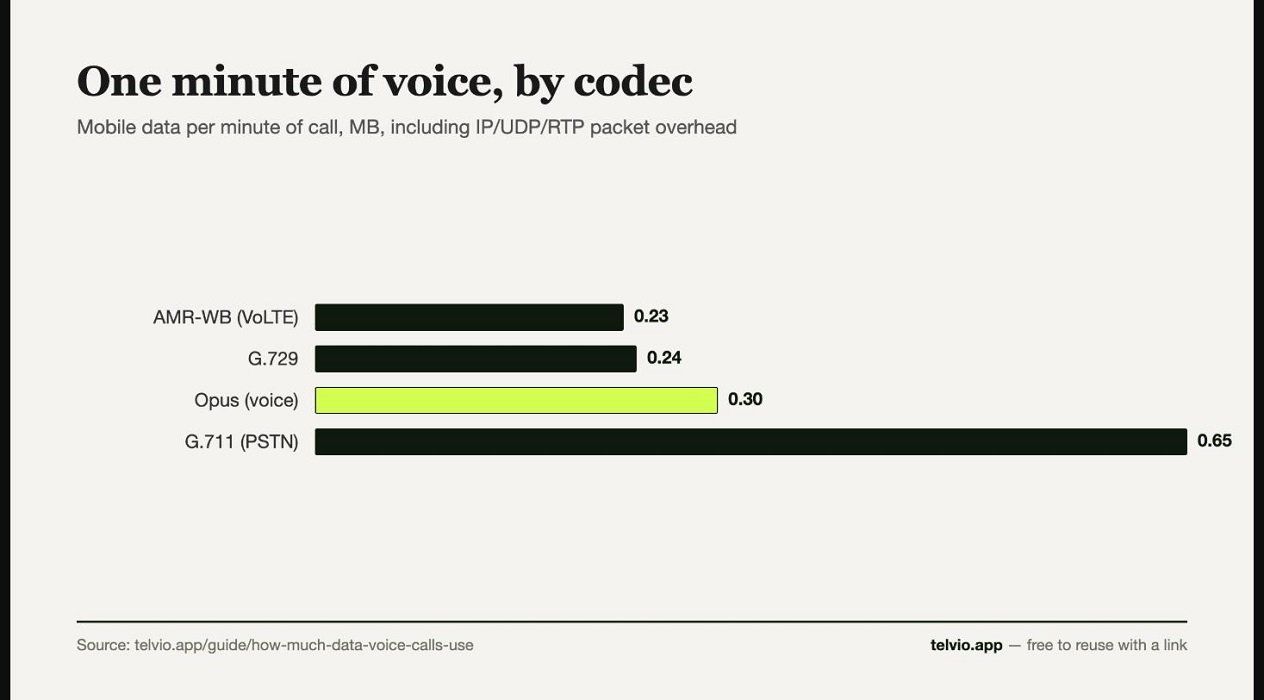
The app samples your microphone and runs it through a codec — in modern apps almost always Opus, which encodes usable speech at 16–24 kbps. The encoded frames are wrapped in RTP over UDP and sent every 20 milliseconds. Packet headers add real overhead: IP, UDP and RTP together cost about 40 bytes per packet, which at the standard packet rate adds roughly 20 kbps on top of the payload. All included, an Opus voice call runs at about 40 kbps — roughly 0.3 MB per minute. If you want the full arithmetic per codec, this reference on how much data a voice call uses tabulates payload bitrate, overhead, and per-hour totals for Opus, G.729 and G.711.
Signaling travels separately. SIP — a text protocol that looks a lot like HTTP — negotiates who is calling whom, which codecs both ends accept, and where the media should flow.
The gateway: where the internet ends
The interesting part is termination. Your packets reach a media gateway operated by the provider’s carrier partner, and that gateway does two conversions at once: it transcodes the audio into G.711, the 64 kbps format the telephone network has used since the 1970s, and it translates SIP signaling into SS7, the telephone network’s own protocol. From the gateway onward, your call is indistinguishable from any other phone call, which is exactly why the person answering needs no app, no account and no internet.
That last hop is also where the price is set. The carrier that owns the receiving line charges a termination fee, and those fees are set per country by local carriers and regulators — not by distance. This is why the same app charges $0.02 a minute to a Mexican number and $1.20 a minute to a Spanish one (Telvio’s published rates, July 2026): the packets travel comparable distances, but the regulated last mile differs by a factor of sixty. Distance stopped mattering decades ago; jurisdiction never did.
Why calls fail when bandwidth is fine
A 40 kbps stream fits in any connection, so bandwidth is almost never the problem. Voice quality dies on three other metrics: latency above roughly 150 ms one-way makes people talk over each other; jitter — variance in packet arrival — overruns the receive buffer and causes robotic artifacts; and packet loss above a few percent produces dropouts, though Opus conceals isolated losses surprisingly well. This is why a call can sound terrible on a fast but congested network and perfect on slow hotel WiFi.
The failure mode engineering cannot fix is the one before the network: a muted or misconfigured microphone. A thirty-second online mic test before an interview or an important call catches the problem while it is still free.
Bottom line
An app-to-landline call is three systems in a relay: Opus over RTP across the internet at about 40 kbps, a media gateway that transcodes to G.711 and speaks SS7, and the receiving country’s telephone network for the last mile. The internet leg is nearly free and nearly perfect; the cost lives in the regulated termination fee, which is why per-minute prices vary by a factor of sixty between countries on the same service, and the quality lives in latency and jitter rather than bandwidth.